My battery died at a convenience store near Green River, Utah. I asked a guy who was driving a brand new BMW for a jump. He was wearing a pink polo shirt, and he was traveling with his sister. He looked at me, then he looked at my bug-splattered truck, and I could tell he didn't like the idea of our cars coupling up. In the end, basic decency prevailed, and he popped his hood. We couldn't find his battery. Maybe these new German cars don't run on batteries, I joked. He didn't think that was funny. It turns out the battery was in the trunk, but I didn't find that out till later, after I called Triple-A, and some drunk guy in a tow truck started my car. I was looking for the Utah Launch Complex. I read about it somewhere. There were rumors about UFO's. I pulled off the freeway and drove a few miles down crumbling blacktop. The main gates were thrown wide open. I stopped my car and got out. It was quiet except for the clatter of the wind in some aluminum-sided buildings up ahead.
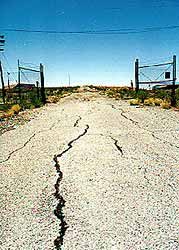
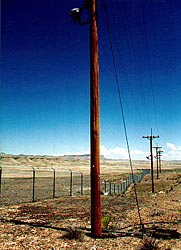
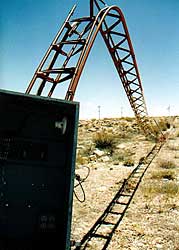
The launch complex was surrounded by a prickly razor-wire fence and regularly-spaced floodlights. Any second now, I figured, some truck full of guards would come tearing out of the desert, and pin me down with machine guns. Even after I'd walked around the whole site, I still felt uncomfortable. Maybe paranoia has its own half-life. Maybe it'll linger out here, long after the last building rusts away. I parked my car on top of a hill and looked around. The complex wasn't very large, maybe 10 acres. I was parked by the blockhouse, a big cement bunker that must have been the headquarters. Slithering out from the blockhouse were aluminum tracks that had thick cables running through them.
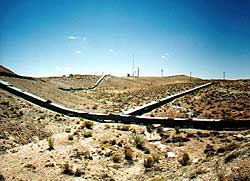

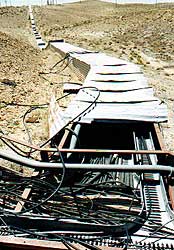
The wire tracks criss-crossed the complex, rolling up and down, following the terrain.
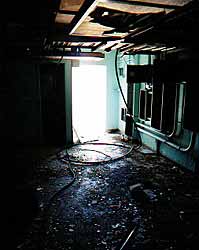
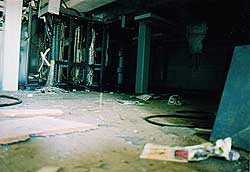
I knew this building was called the blockhouse because there was a sign stenciled by the door that said "No Smoking in the Blockhouse." The building had thick concrete walls, and the whole place was buried under a mountain of dirt. Inside, the temperature dropped. It was cool and dark and smelled like electronics. There were acoustic tiles in the ceiling and fluorescent lights. All the fluorescent tubes were smashed, and my shoes crunched over the broken glass. The place was full of wires; I guess all the wires running throughout the complex were tied into the blockhouse. Big stainless-steel electronics racks stood against the walls, but all the components were missing. To the right of the door were a couple offices. I shined my flashlight into one of them. It was full of rabbit shit.
I walked down from the blockhouse past a sentry post. Just beyond the post was a big building that looked like a barn. That's where they assembled the missiles. Behind the sentry post, there was a little pile of dirt. An earthen berm was all that protected the sentry if one of the missiles accidentally blew up. I counted three other missile assembly sites around the complex, but only at one was the assembly building still standing.
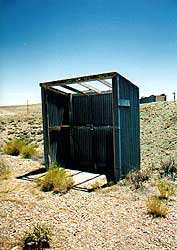
A big shed with styrofoam padding on the walls sat at the far end of a long concrete pad. I think this is where they put the missiles together. The shed was on tracks, and the tracks ran the entire length of the pad. Inside, the building was full of cow poo. I guess that's all these super-secret buildings are good for anymore: a toilet for cows and coyotes and bunnies. I wandered around to the far side of the building and pushed on it really hard. It didn't budge.
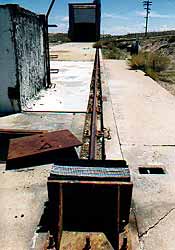
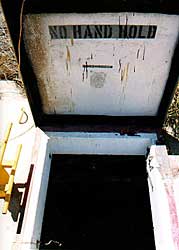
Off to the side, I found an open hatch that led down into a tunnel. The whole site was like that: all the hatches were unhatched, all the locks were unlocked. It was like someone was trying to prove there was nothing to hide out here. It made me suspicious. The hole went down maybe 15 feet. There used to be some ladder rungs, but they were torn out of the wall. Someone had tied a steel cable to a pole and dropped it in the hole. I decided not to climb down.
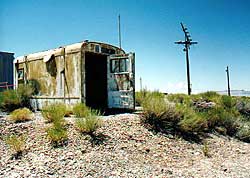
I visited the site twice last summer: once on the way to Reno, and once on the way back. On my second visit, I wandered around, and everything was as wide-open as before. Then I got to the blockhouse, and one of the steel blast doors was shut and battened. Seeing that big old door closed tight suddenly made me feel alone, and far from help. I decided to call it a day. Just to the side of the assembly building, I came across this mobile home. It was dotted with bullet holes.
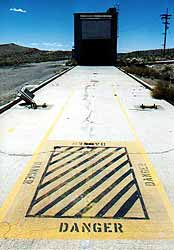
I walked to the far corner of the complex, where there was another missile assembly area. The assembly shed was gone, but there was still the long concrete pad with a 'danger' sign painted on it. Nearby, there were a couple telephone poles with numbers on them. Long metal rods that looked like fly swatters stuck out from the sides.
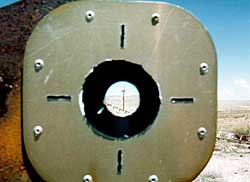
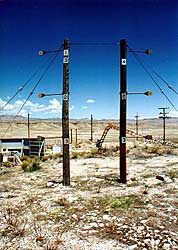
The fly swatters had target holes cut in them, marked off with crosshairs. I stared at the poles for a while. I liked the idea that there was something to aim at out here, in the middle of the Utah desert. Something to track, to lock onto. Or maybe that was the problem. Maybe there were no targets to hit. Just lots of empty space. Maybe that's why the missile guys packed up and left.
People don't seem to know what to do with ruins. Like it's not enough just to let them fall to pieces. They have to be interpreted and stabilized. Maybe demolished. Maybe restored. I read somewhere that America has more acreage dedicated to ruins than to parkland. I don't know if I believe that. And if it's true, I don't know if I mind.
There's no graffiti at the launch complex. That's one of its creepiest features. It's obvious that kids come out here. They've smashed all the windows and left behind beer cans and shotgun shells. But there's no spray paint. At first, I thought maybe the desert sun faded it all away. Then, finally, in a far corner of the place, I found a tag: $.A.M., 5-19-73. Twenty-five year-old graffiti. And that was it.
|